

Top SEO tips for EV websites
Table of Contents
Introduction
As I started looking to replace my current car, I noticed how many new EV options are out there, so I started looking through this area of the Internet a bit more. Being an SEO doesn’t stop in my spare time, so I took note of some factors I would definitely include in my SEO strategy if I worked in the EV vehicle space. This is not a full strategy, just some tips that I think could help some brands stand out of the crowd.
Note this blog may not be fully beginner friendly, and there may be some areas that require a more advanced understanding of SEO.
Schema Markup for Electric Vehicles
Any website selling electric vehicles can get an advantage over the competition by implementing robust schema markup. This can provide extensive SEO benefits, as the schema leads to search engines having a better understanding of the meaning and context of your content, which can unlock display features in search results as well as increased rankings for both branded and non-branded keywords.
The most important markup in the EV vehicle space is the Car Markup. I will not discuss the entire markup availability, as this can be followed directly from the link.
The Schema developers have accounted for the rise of electric vehicles and provided guidance on how the traditional schema markup can be adapted to fit electric vehicles. The table below showcases the main properties where ev listings will be different from traditional ones.
Property | Notes |
emissionsCO2 | The CO2 emissions in g/km. When used in combination with a QuantitativeValue, put “g/km” into the unitText property of that value, since there is no UN/CEFACT Common Code for “g/km”.
For electric vehicles, ensure you put 0 on this value. The lack of emissions in electric vehicles should be fully taken advantage of, especially as Google pushes for sustainability in its product offering. |
fuelCapacity | The capacity of the fuel tank or in the case of electric cars, the battery. If there are multiple components for storage, this should indicate the total of all storage of the same type.
The unit code electric vehicles should feature is AMH (ampere-hours). This can help easily differentiate between different battery sizes. |
fuelConsumption | The amount of fuel consumed for traveling a particular distance or temporal duration with the given vehicle (e.g. liters per 100 km).
Note 1: There are unfortunately no standard unit codes for liters per 100 km. Use unitText to indicate the unit of measurement, e.g. L/100 km. Note 2: There are two ways of indicating the fuel consumption, fuelConsumption (e.g. 8 liters per 100 km) and fuelEfficiency (e.g. 30 miles per gallon). They are reciprocal. Note 3: Often, the absolute value is useful only when related to driving speed (“at 80 km/h”) or usage pattern (“city traffic”). You can use valueReference to link the value for the fuel consumption to another value.
Battery consumption is a crucial element of electric vehicles, therefore take advantage of this property to highlight the battery properties of the car. I recommend using fuelEfficiency , as in the UK most consumption metrics relate to miles per gallon. Also, I suggest using a valueReference that fits the rest of your marketing strategy (e.g. use city driving related metrics to describe a the efficiency of a city car like the Toyota Aygo.) |
fuelEfficiency | The distance traveled per unit of fuel used; most commonly miles per gallon (mpg) or kilometers per liter (km/L).
Note 1: There are unfortunately no standard unit codes for miles per gallon or kilometers per liter. Use unitText to indicate the unit of measurement, e.g. mpg or km/L. Note 2: There are two ways of indicating the fuel consumption, fuelConsumption (e.g. 8 liters per 100 km) and fuelEfficiency (e.g. 30 miles per gallon). They are reciprocal. Note 3: Often, the absolute value is useful only when related to driving speed (“at 80 km/h”) or usage pattern (“city traffic”). You can use valueReference to link the value for the fuel economy to another value. |
fuelType | The type of fuel suitable for the engine or engines of the vehicle. If the vehicle has only one engine, this property can be attached directly to the vehicle. |
meetsEmissionStandard | Indicates that the vehicle meets the respective emission standard. |
vehicleEngine | EngineSpecification Information about the engine or engines of the vehicle. |
Based on the table above, my recommendation is also for each listing to have its own dedicated page, to make the schema as effective as possible. Adding schema for multiple cars on the same is possible, but not desirable.
Content
In the context of vehicles (including EVs), brand is not only the make of the car, but also the model. As an example, the Ford Ka and Ford Ranger belong to the same manufacturer, but they cater to completely different audiences and offer very different value propositions. Searches including both the make and the model are very common in automotive SEO. To capitalise on these volumes it is advised to create separate pages for each subbrand you sell.
As an example, if you are an auto dealership selling all makes and models, you may want to create a page for each make (e.g. Ford, Toyota, Jaguar etc.), a page for each model (e.g. Ford Transit, Ford Ka, Ford Ranger etc.) and individual listing pages for each car to be displayed in the previous two.
This way, you can cover the largest keyword profile and also provide a targeted experience for your users, allowing them to easily navigate according to their needs.
Off-page Digital PR
High volume searches such as “best ev” A very surface exploration of keywords around the “best ev” topic yielded many keywords (see below) with two sharing characteristics: medium but upwards trending volumes, and high difficulty. These keywords should form an important part of an SEO strategy for electric vehicles, as they indicate a propensity of people reaching for beginning of the funnel, informational content, a great place for any marketing strategy to start.
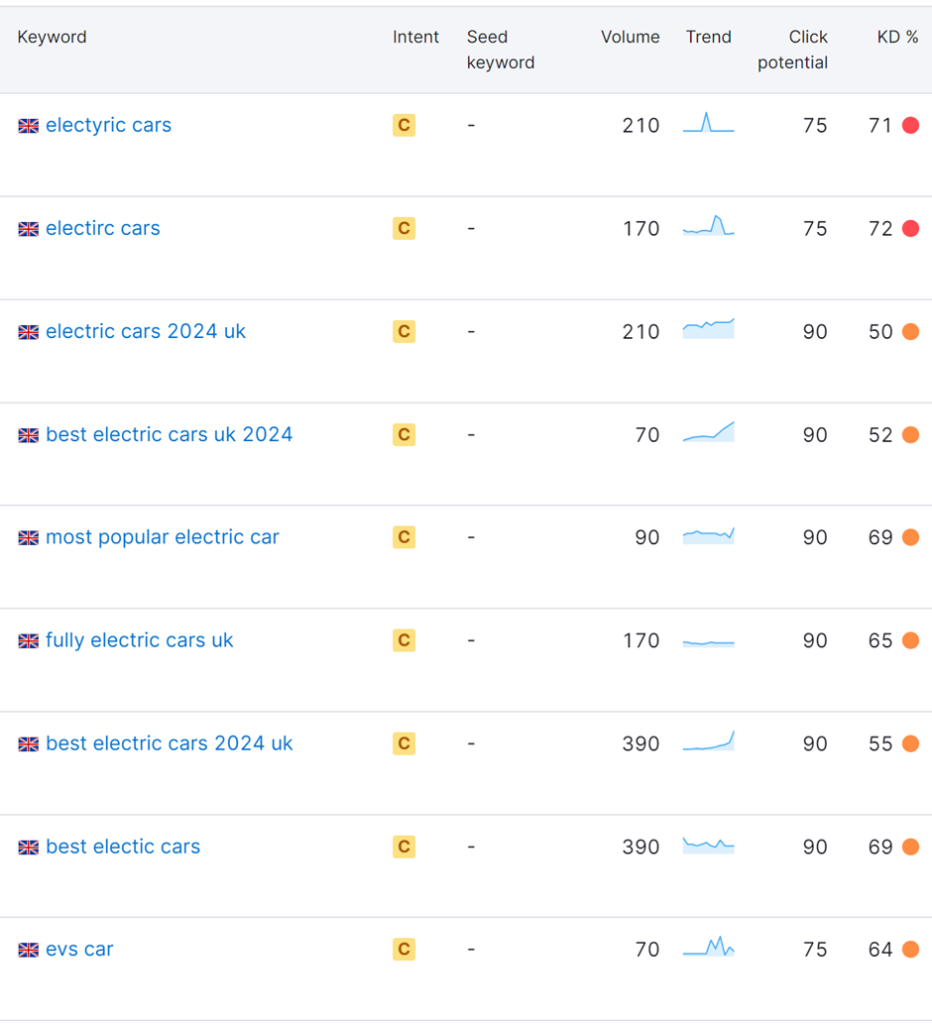
Analysing the search intent and expected results, we can deduce that third party websites are best placed to answer the demand. Noone would ever believe that Tesla Model 3 is the best electric car if the information sits on the Tesla website. However, if a reputable automotive website publishes a listicle of what they believe the best electric cars are, this will be viewed more impartially, and therefore become more trustworthy. The keyword difficulties from the list above is testament to that, as they show only highly reputable domains would be able to rank highly for these searches.
Therefore, a good strategy for electric car manufacturers to show up in these searches is to be part of the listicles formed by third party publications. This will take PR finesse. A website with first party interests in selling cars should not attempt to rank for these keywords, as most likely this will take great effort and resources to yield little results.
However, as far as SEO is concerned, digital PR is heavily performed for link building outcomes. In this scenario, links should not form part of digital PR campaigns. Although links will be benefic for the overall ranking of the website, the main purpose of digital PR for targeting these keywords should be to introduce the brand (in this case, make and model) to the audience, and then rely on branded SEO for further touchpoints.
Bonus - UX
One of the key talking points in the electric vehicle space, especially from a consumer perspective, is the efficiency and reliability of charging. With an infrastructure still in development, it’s easy to understand why this is the case. To illustrate this, I looked at the seed keyword “ev”. The table below shows the top 15 keywords in relation to this seed. It’s no surprise that 9 out of the 15 keywords are relating to the charging aspect of owning an electric vehicle.
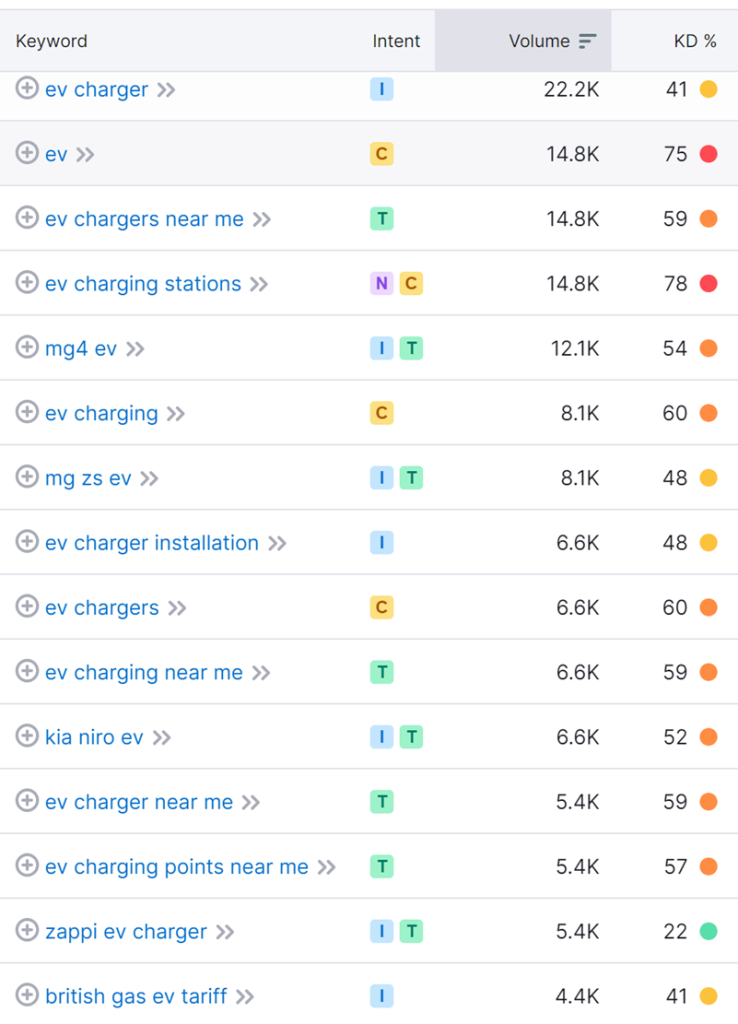
Understanding the impact ev charging has on the buyer decision process can create an amazing opportunity for electric vehicles sellers to show how their cars fit the lifestyle needs of their market.
A great idea to improve the user experience of web visitors is to introduce a milage calculator, where users can input their desired starting point and destination (most commonly the home to work route) to understand the consumption of their new electric vehicle. The calculator can show how much battery percentage is used on each trip, and to take it one step further, you can even show where charging points are on the route. All this is achievable with the Google Maps API, which can be used as the basis for understanding distances and POIs.
This idea isn’t completely new and revolutionary, as Google has introduced a similar concept in search results. I have not seen this new feature in UK searches yet, but it will most likely be coming in the near future. See below an example with some basic design.
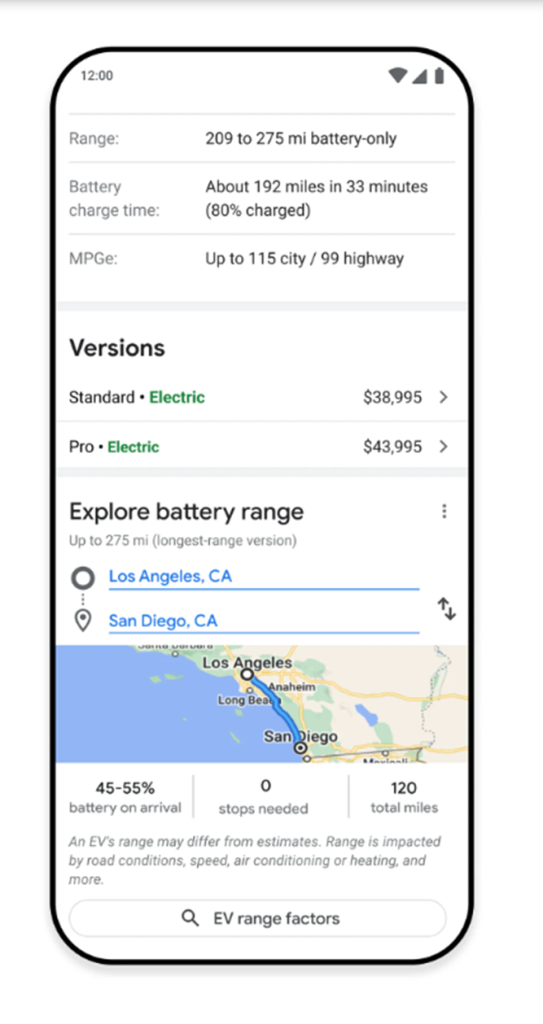
By having a tool like this on your website, you ensure your users stay on the page while doing the calculation, preventing them from jumping on another website. For the CRO whizzes out there, this can also be a great opportunity to introduce upgrades to different size and performance packages, in an attempt to craft the perfect offering fitting the user’s lifestyle needs.
Final Thoughts
The EV space is getting more and more competitive, as most manufacturers now offer products fit for the general public. With this trend we can also notice an increase in searches around electric vehicles, which means the SEO space is going to become more important than ever, and the real estate at the top of the page will be more difficult to get. A good understanding of the search pool and intent will be paramount in designing the experiences that will ultimately get users to convert.